
During my five years in the RCN, I spent nearly two years on HMCS Athabascan, (besides the Frigate Lauzon, and Minesweeper Quinte).
Recruited as a so-called ‘engineer’ and first drafted to the Frigate Lauzon, soon found that working in the engine room was not my cup of tea. So I applied, along with a buddy, (Joe Hoebeck), for a change of trade to ‘Radar Plotter’ department while still on the Lauzon
After several weeks training course at naval station HMCS Stadacona shorebase in Halifax, I graduated at the head of my class and was then drafted to the destroyer HMCS Athabascan, a WW!! relic. Thereafter I was standing watches in the operations room, monitoring radar, tracking surface ships and aircraft.
The Athabascan was a veteran of the Korean war, or should I say a ‘victim’ of that conflict.? During my time on it in the 1960’s only one of its two steam-powered boilers was operational. Evidently, during its Korean war experience, a mortar had actually scored a direct hit down one of its stacks, completely disabling one of its two boilers, and yet, amazingly, had not succeeded in sinking her!
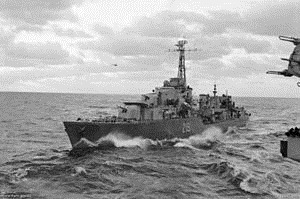
The Athabascan was unable to reach its designed top speed of something like 38 knots with only one operational steam boiler, and, as a ‘Tribal Class’ destroyer, nor was it ever particularly seaworthy in heavy sea conditions. These war ships were designed for fighting, not high seas.
During one such heavy sea event in the North Atlantic, a wave completely overwhelmed the ship from bow to stern. A Deck Officer on duty on the exposed upper bridge was knocked off his feet and sustained a broken leg.
In winter months it was necessary for crew to chip sea-ice from the upper deck – the consequence of not doing so could eventually result in the ship losing equilibrium, and ‘turning turtle’, which apparently happened to more than a few war ships during the second world war. In fact we lost a ship’s cook crewman during winter operations. He was swept off the upper deck by a wave as he tried to make his way back to his aft living quarters. On Tribal Class destroyers the only way you could go from fore to aft was on the upper deck by hanging onto a sliding rope, attached to a cable. Of course we did a standard search pattern for him, but there was no chance anyone could survive in the freezing Atlantic for more than seconds.
However I do have some fond memories of slinging my hammock on the upper deck in relatively calm Southern waters, only to be awakened in the middle of the night by increasing sea-spray and hastily repairing back to secure lower decks. Hammocks had to be re-slung each day in the lower deck ‘mess’ and stored daily, except for watchkeepers.
May final draft was to the Minesweeper Quinte, a wood and aluminum constructed ship designed to counter various types of coastal mines. It had far more comfortable crews quarters, even actual bunk beds! I crewed on it up to my honorable discharge in the early 60’s.

Such experiences will not be forgotten, just as reading Bible study books at sea. In fact at one point I actually began a Bible study with a Swedish bosun’s mate friend by the name of ‘Oly’. (We were discovered under the cover of a life-boat while doing so 😉
Indeed, those were memorable times for me. While I cannot recommend volunteer RCN membership owing to my beliefs now, it was of some value to my learning discipline as a rebellious teen.
Discover more from New2view's Blog
Subscribe to get the latest posts sent to your email.
Wohh exactly what I was looking for, thank you for posting.
This post has been extremely insightful and useful to increase my knowledge in the field of knowledge and its many facets. Thank you very much, I will certainly come back to visit often and definitely tell some of my internet-inclined friends to visit this site. Keep posting and expressing your knowledge and opinions strong!